In my most recent race I had the joy of dealing with knee pain. It was a less than ideal situation for the last eight miles of the run. Any time I have a situation like that I like to analyze it afterwards and hopefully learn from it in order to prevent it from happening again. So here goes. I think there are are two possible options of how I wound up in this situation. Most likely it was a combination of the two.
TRAINING
This year I used an intermediate training plan. I wanted to try a more aggressive plan from a new coach as I attempted to break the 12 hour mark. All in all I really liked the plan and 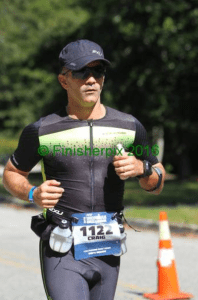 will very likely use it again in the future. Given my current fitness I think it adequately prepared me for the swim and the bike.
The one thing I noticed when first reviewing the plan was the run build. In 2015 some run workouts were based on time but each Sunday it had a long run based on mileage. Each week the mileage built up to 20 miles which, given my pace, equates to ~3.5 hours. In 2016 my plan maxed out at 2:20 which turned out to be ~13.5 miles. About half the mileage of race day. There was a second run later that day of 4 miles so that put my longest run day at 17.5 miles but still my longest single run was 13.5. Another factor is that my 2015 20 mile run was pretty much a nice even pace. My 2016 2:20 run included several intervals (five to be exact) at increased paces. Throwing in the intervals stresses the body more than an even pace and winds up simulating a longer run in a shorter time.
Interestingly a buddy using an intermediate plan from another coach had pretty much the same regimen. We discussed it and concluded that there must be some method to the madness so we went with it. I’ll pause for a minute here and talk about my run history. Several years back when I started running I would get knee pain around mile 8. As I ran more it moved to mile 12, then 15, and then finally went away. In my 2015 race I had no issues. Still in the back of my mind I figured I needed more mileage in a single run just due to my history.
Keep in mind that faster runners than me cover a lot more ground in 2:20 than I do. In the end that’s what I think it all came down to. While I’m a fairly solid cyclist my marathon running is still not up to par with the more competitive athletes in my age group. At the end of the day I should have gone with my gut and grabbed at least one longer run.
THE BIKE
Post race I had pretty much concluded that I knew what went wrong. A few days later I was back home and I decided to hit my legs with a roller for a few minutes. I started on my left leg and as I approached the IT band I expected some pain as that is where I had felt in on race day. To my surprise there was no pain to be found anywhere on my left leg.
Then I hit my right leg. Oh man. The entire thing was like a rock. Quads, IT band, it all hurt. I sat there puzzled as I continued to roll. My mind went back to race day; zero right leg issues on the run. Oh yeah, I completely forgot about…the bike. The bike at IMNC had pretty steady head / cross winds for a little over two hours. The winds were coming either head on or into my right side. I was riding a disc wheel that basically acted like a parachute catching the cross winds. In an effort to keep my bike upright I wound up taxing the right side of my body as I leaned into the wind for much of those two hours. By the two hour mark my right groin was crazy tight, something I’ve never had happen on a ride before. As I started the run I expected to have issues down my right side but was pleasantly surprised that all was smooth sailing until my left knee started hurting at mile 18.
As I finished rolling out my right leg for the first time the thought crossed my mind – maybe the stress put on my right side for a large portion of the bike meant that my left side had to over compensate on the run, ultimately causing the knee pain. I’ll be the first to say that I don’t fully understand the mechanics of the human body. But in my simple mind it seems like at least a possibility.
CONCLUSION
As I said in the opening, my best guess at this point is that some combination of the two scenarios led to my ultimate demise. A longer training run probably would not have hurt anything. But neither would having better winds on race day.
I write all of this as if I failed miserably; the reality is that I had a run PR by 20 minutes. Best case scenario I was hoping for 30. I think that alone proves the benefits of the type of running I did in 2016. I ran more miles in 2016 training than in 2015; they were simply shorter but more frequent. Going forward I’ll likely continue to use this approach as it feels like it does less damage on my body.
Much of 2017 will be focused on long distance running. When I race my next IM in 2018 I would love to be knocking on a 4 hour run. That means my open marathon times need to be, well, under 4 hours (paces need to be down in the 8’s). At the moment that doesn’t seem possible. I’m reminded of one of the better Tony Horton quotes:
Don’t say I can’t, say I currently struggle with…
I currently struggle with marathons. With a little luck and a lot of work hopefully all of that changes in the next year.
 slowpope